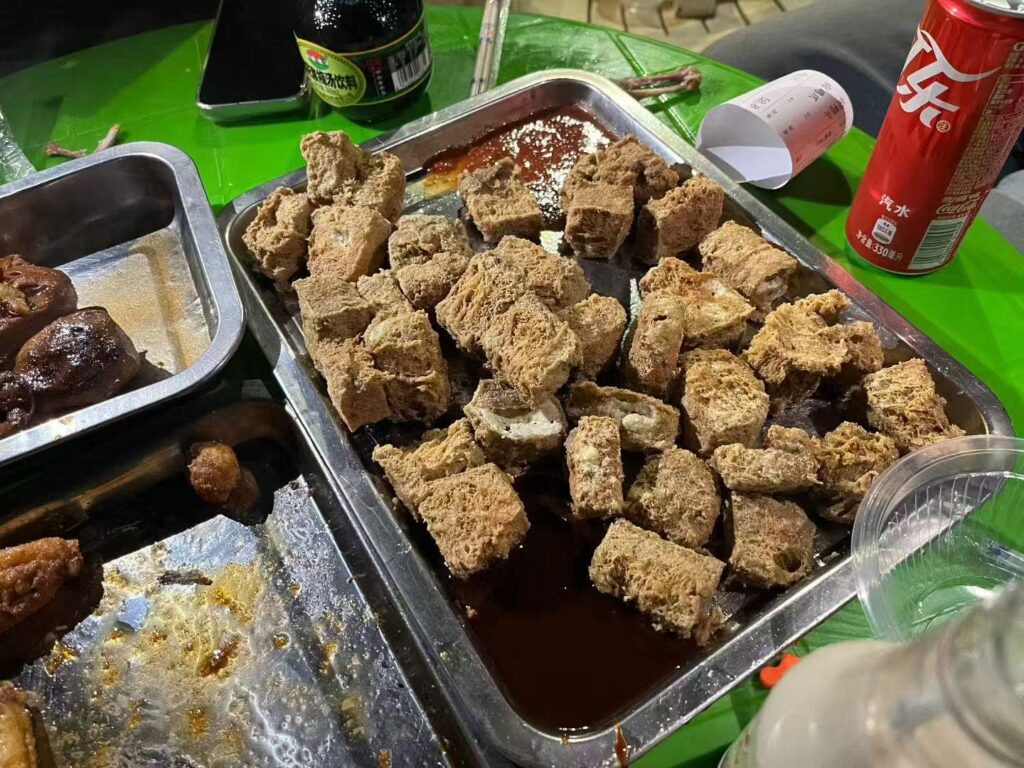
I eat stinky tofu at midnight by West Lake—alone.
Not because I’m brave. But because, after 15 years of living in Hangzhou, I’ve learned this city doesn’t just tolerate solo women—it quietly makes space for them.
When foreign friends ask, “Is China safe for solo female travelers?” I don’t give statistics. I tell them about the night snack stall that only appeared after 12 AM, the rain-soaked queue, and the fat chef who now runs his own shop just steps from the lake.
Let me explain.
Stinky tofu (chòu dòufu) is fermented tofu, deep-fried until golden and crisp. To the uninitiated, it smells like a mix of blue cheese, gym socks, and something you’d rather not identify. But bite into it—crackly outside, soft inside—and you taste umami, garlic, and a hint of fermented brine. It’s an acquired love, like jazz or rainy Sundays.
Ten years ago, my favorite stall had no name, no sign. It rolled up on a quiet side street near West Lake only after midnight. Locals knew. Tourists didn’t. I once stood in the rain with two friends for two hours, shivering but laughing, just to get a paper cup of that hot, pungent magic. The story made it into a local newspaper: “The Phantom Snack of West Lake.”
Today, the vendor—affectionately called “the Fat Chef”—has a tiny shop five minutes from the lake. He’s not just a street cook; he’s a food obsessive who travels to Bangkok, Tokyo, and Istanbul to study street food. His menu still features the legendary stinky tofu, plus fried skewers of lotus root, quail eggs, and even lotus seeds. Everything comes with two sauces: one sweet, one “spicy.”
(Honestly? The spicy one isn’t spicy at all—Hangzhou has never been a chili city. But both are salty in that comforting, old-school way.)
I always bring first-time visitors here. Not just for the food, but for the lesson: in China, the best things often hide in plain sight—if you’re willing to stay past closing time.
After dinner, I walk.
By 11 PM, the tour groups are gone. The lake is still. The willows brush the water like ink strokes on silk. I take off my shoes and walk barefoot on the cool stone paths of Su Causeway. No one stares. No one follows. The only sounds are frogs, distant temple bells, and my own breath.
This is Hangzhou’s secret: it’s safest when it’s quietest.
Yes, language is a barrier. But today, I point my phone at a menu, tap Google Translate, and say the phrase out loud. The vendor laughs, nods, and adds an extra skewer “for the effort.” Most locals don’t expect you to speak Chinese—they just appreciate that you tried.
And yes, scams exist. Avoid “free tea” offers near Lingyin Temple. Stick to Didi for late-night rides. But these aren’t signs of danger—they’re signs of a living, breathing city. Just like Paris has pickpockets and New York has subway scammers, Hangzhou has its quirks. Navigate them with awareness, not fear.
What I love most, though, is how deep this city goes.
Hangzhou is called “the city of museums.” Go beyond the lotus ponds and willow trees. Visit the China National Tea Museum, where you can sip Longjing tea in a bamboo courtyard. Wander the Hangzhou Arts & Crafts Museum, filled with Song Dynasty woodwork and silk embroidery—most exhibits have English descriptions.
Because here’s the truth:
China’s surface is beautiful—mountains, lakes, ancient temples.
But its soul lies in history, restraint, and the quiet pride of people who’ve lived through centuries of change.
So if you’re a woman thinking of traveling alone to China—
Come to Hangzhou.
Eat stinky tofu at midnight.
Walk West Lake when the moon is high.
Get lost in a tea field in Meijiawu.
Visit a museum and sit quietly in front of a 900-year-old painting.
You won’t be unsafe.
You’ll just be… seen, not stared at.
Welcomed, not watched.
Alone—but never lonely.
And if you see a chubby man in a tiny shop near West Lake,
tell him you read about him in my story.
It’s our little code—not for a discount, but for a nod, a wink, maybe an extra skewer, and the start of a real Hangzhou moment.